ChatGPT Ads Arrives in Italy: Advertising Learns to Converse
News
Focus
Introduction
There's always a moment when a platform stops being just a place where people search for something, and becomes a place where something gets sold to them. For ChatGPT, that moment in Europe begins on August 24, 2026.
We're not talking about yet another banner tucked into a corner of the screen. We're talking about a genuinely different way of reaching people: not while they're typing three keywords, but while they're explaining, in full detail, what they're actually looking for.
In this article we'll cover what ChatGPT Ads actually is, how it works, what it costs (spoiler: nobody knows for sure yet), and why, in our view at sixeleven, the right question isn't "SEO or paid ads", but how to make the two work together.
What Changes From August 24, 2026
On August 18, 2026, OpenAI announced the expansion of ChatGPT Ads to 31 European countries, including Italy, alongside Germany, France, Spain and other key markets. The move comes six months after the pilot launched in the United States, a period OpenAI used to build a full-fledged advertising infrastructure: bidding systems, targeting and measurement tools.
Compared to the initial announcement, however, there's one development that changes things considerably: since August 31, anyone can open Ads Manager and launch a campaign on their own. During the first week, access was limited to OpenAI's Ads Solutions team, select partner agencies and technology partners. Self-service is now live in Italy too, well ahead of the Q4 2026 timeline originally expected.
The rollout is moving faster than anticipated, even though the platform is still in beta and constantly evolving. But the direction is clear: ChatGPT is no longer just a conversational assistant; it's becoming a fully fledged advertising platform.
How ChatGPT Ads Actually Works
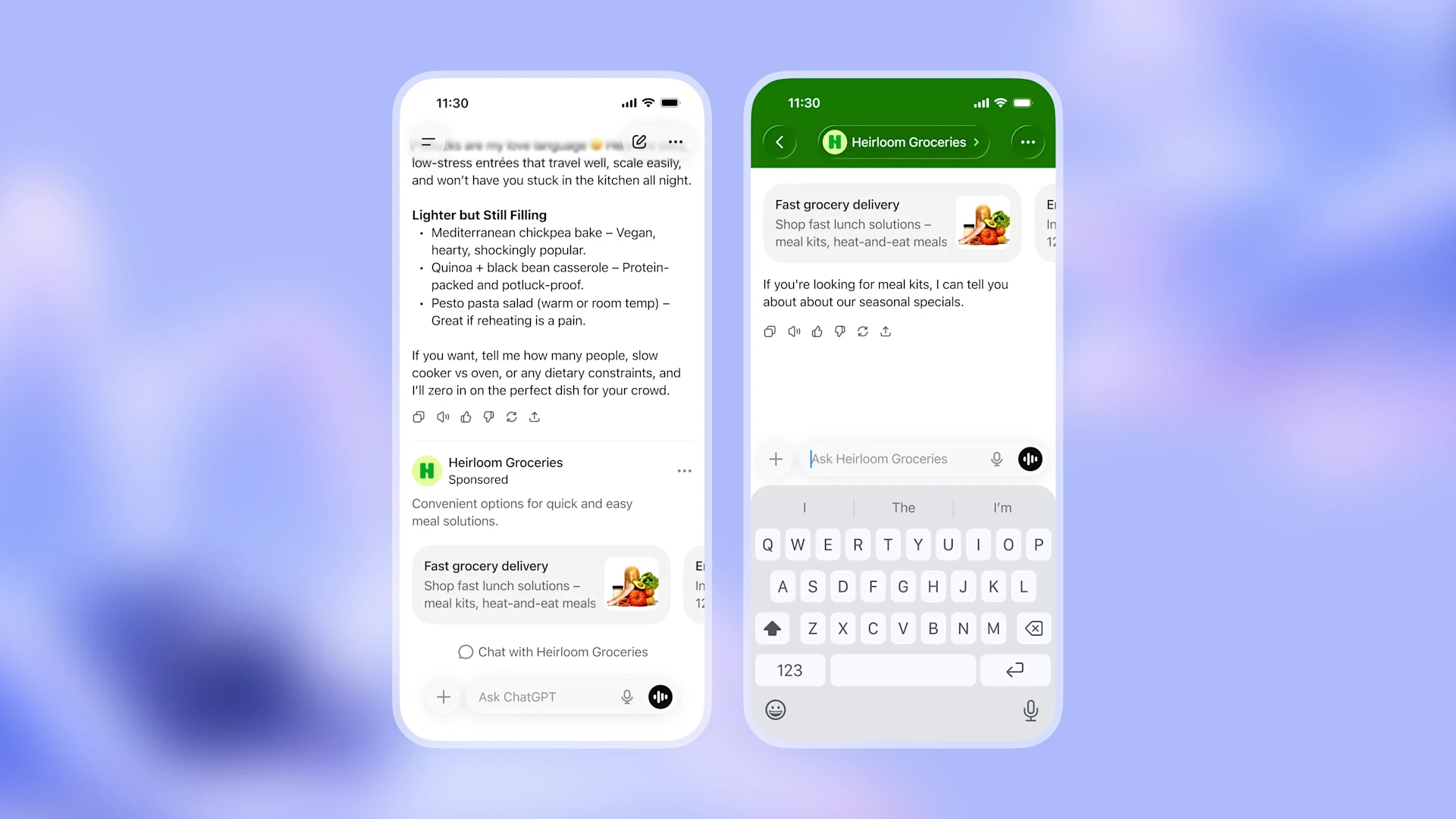
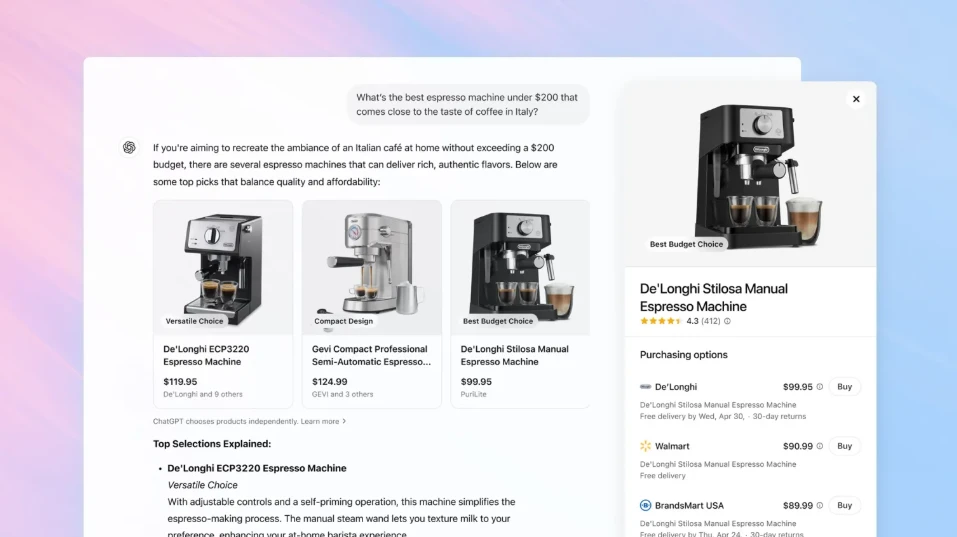
ChatGPT Ads shows ads that appear within the conversation itself, when they're relevant to what someone is researching, comparing or weighing up. The interesting part isn't where they show up, it's when.
On Google, that same need would probably turn into a short, dry search like "best CRM small business". On ChatGPT, a small business owner might instead lay out their whole situation: how many employees they have, how they sell, which features actually matter to them, and how much they're willing to spend.
There it is: that single message carries a budget, a context, a real problem. It's a level of intent that neither a search query nor a declared social media interest can match with the same precision.
Organic and Paid Remain Two Different Things
OpenAI has drawn two fairly firm lines: ads must always be clearly labeled as advertising, and no advertiser can pay to change the answers ChatGPT gives to users.
In practice, this means that showing up organically in a ChatGPT answer (because a brand is authoritative, well-structured, widely referenced online) and showing up through a paid campaign remain two distinct strategies. They call for different skills, but in our experience they work best when built together.
Courtesy of OpenAI
How Spend Actually Works: CPM, CPC and oCPC
On the technical side, ChatGPT Ads launched with a simple model, CPM (cost per thousand impressions), later joined by CPC (cost per click). In 2026, oCPC arrived too: cost per click optimized for conversions.
That detail says a lot about OpenAI's ambitions: the platform isn't content to stay a pure awareness tool, it's aiming to become a performance channel, where results can be measured, optimized and benchmarked against real business goals.
Backing that direction is a set of targeting upgrades: geographic targeting and personalized audience segments (Custom Audiences), particularly useful for anyone operating in specific territories — professional practices, local businesses, B2B services tied to a particular region.
Who Will Actually See the Ads
Not every ChatGPT user will be exposed to advertising. Ads appear on the Free and Go plans, while higher-tier paid subscriptions remain ad-free.
That's worth factoring in before even thinking about budget: understanding what portion of the audience is actually reachable through ChatGPT's ad inventory is the first step of any serious planning.
Measuring Conversions: OpenAI Pixel and the Conversions API
Another sign that the platform is maturing is the arrival of dedicated measurement tools: OpenAI Pixel, a Conversions API, and integrations with a handful of third-party measurement platforms.
The logic is the same one we're used to on other ad platforms: what matters isn't just who saw or clicked the ad, but what happens next. Impression, click, landing page visit, quote request, purchase: every step becomes a data point to build real optimization on.
For anyone who wants to take ChatGPT Ads seriously, this boils down to one thing: the work doesn't end when the ad goes live. You need proper tracking, landing pages built to convert, and clear goals from day one.
How Much Does Advertising on ChatGPT Cost?
Let's be blunt: there's no reliable benchmark price right now. The platform supports several bidding models (CPM, CPC, oCPC), and real costs will depend on market, competition, goals and industry.
So be wary of anyone already quoting firm benchmarks for CPC or ROI in any given market: it will take months of real data before anyone can speak with actual authority. Anyone promising certainty at this stage is probably just guessing.

Courtesy of OpenAI
Will ChatGPT Ads Replace Google Ads? Wrong Question
In the short term, no. Google still handles billions of searches every day, backed by an extremely mature advertising ecosystem. Meta, for its part, still holds a depth of data and formats that ChatGPT hasn't built up yet.
But maybe the right question isn't "Google Ads or ChatGPT Ads", but: at which stage of the buying journey can I reach my customer most effectively? Search, social and conversation are becoming complementary pieces of the same journey, not competing channels.
Will the Other AI Platforms Follow Suit?
Fair question: if ChatGPT has opened the door, what will the other major conversational AI players do? Right now, the answer is anything but uniform.
On Gemini, Google's official line remains cautious: in late 2025, the company publicly pushed back on reports of an imminent ad rollout inside the Gemini app, stating there were "no plans" to do so. But read closely, those denials leave more room than they appear to: some Google executives have framed it as a matter of "prioritization" rather than principle, and in the meantime the company is already weaving Gemini into Search advertising, building new formats where the AI model generates creative and sponsored responses.
And this is where, in our view, the real story is: Gemini isn't being built as a standalone platform, it's part of an already massive, mature advertising ecosystem, Google Ads. If and when ads do land inside the Gemini app, chances are it won't be a brand-new platform to learn from scratch, but simply another inventory slot within Google Ads itself, alongside Search, Display, YouTube and Discover. For businesses already investing in Google's ecosystem, that could mean extending existing campaigns to a new touchpoint, rather than building a parallel strategy.
On Claude, the picture is different: Anthropic has chosen, at least for now, not to introduce advertising into its products, staying clearly outside this kind of monetization model.2
Bottom line: ChatGPT is, as of today, the only major AI assistant to have actually launched a structured advertising system. Gemini is the next most credible candidate, precisely because of how closely tied it already is to Google's ad engine. That said, the picture is still evolving — it's ground worth watching, not something to take for granted.
sixeleven's Take: Why Paid and SEO/GEO Move Together
And here's the point that matters most to us as an agency: the arrival of ChatGPT Ads doesn't make SEO any less important. If anything, it widens the field.
A brand can now be discovered in three quite different ways: because ChatGPT mentions it spontaneously in an answer, because someone encounters it in a sponsored ad, or because they simply still find it on Google. The line between SEO, GEO/AEO, brand authority and advertising is getting thinner by the day.
That's why, before opening the budget, a company should ask itself a few uncomfortable questions: does the website clearly communicate what it sells? Are the landing pages actually built to convert, or are they just digital storefronts? Is the brand recognizable enough online to be cited spontaneously by an AI?
A campaign can drive traffic. But if everything that happens after the click doesn't work, you're simply paying to speed up a strategy that doesn't convert on its own. This isn't a budget problem, it's a foundations problem.
Where to Actually Start
Before opening Ads Manager and thinking about creative and budget, it's worth nailing down a few steps that make the real difference between a campaign that works and one that just burns money:
Map the right moments: figure out which questions or comparisons your product can naturally fit into, without feeling out of place.
Pick one concrete goal: a sale if you're an e-commerce, a sales inquiry if you're B2B, a booked consultation if you're a professional service.
Build a landing page that matches the promise: consistent with the ad's message and designed to convert, not just to exist.
Set up tracking properly: without OpenAI Pixel and the Conversions API correctly configured, every future optimization is just guesswork.
Don't drop your organic work: SEO and generative-engine optimization remain the ground advertising grows on, not an alternative to it.
Only once these pieces are in place does it make sense to talk about budget, creative and bidding strategy.
Want to Know If ChatGPT Ads Makes Sense for Your Business?
As of August 24, 2026, ChatGPT Ads officially opens a new advertising frontier across Europe. For businesses, this isn't just about adding a line to the media plan, it's about starting to think about brand visibility inside the conversations AI is generating.
This is exactly the kind of ground we like to work on: where SEO, GEO/AEO, content and advertising stop being separate departments and become a single, coherent strategy.
If you want to find out whether this new channel could work for your market, we can dig into your potential customers' search (and conversational) intent together, take a look at your website's structure, and map out the real opportunities this new platform offers.
That's exactly what we're here for.
LISTENING IS THE FIRST CHAPTER OF EVERY STORY.
And we can’t wait to write yours.
LISTENING IS THE FIRST CHAPTER OF EVERY STORY.
And we can’t wait to write yours.
Contacts
sixeleven srl sb
Largo Montebello 40/M
10124 Turin - Italy
TAX Code / VAT Number 10182610013
Certificazione ISO 9001:2015 - Certificate ID: 002181-1-IT-1-QMS
GET IN TOUCH —
Contacts
sixeleven srl sb
Largo Montebello 40/M
10124 Turin - Italy
TAX Code / VAT Number 10182610013
Certificazione ISO 9001:2015 - Certificate ID: 002181-1-IT-1-QMS
GET IN TOUCH —
ChatGPT Ads Arrives in Italy: Advertising Learns to Converse
News
Focus
Introduction
There's always a moment when a platform stops being just a place where people search for something, and becomes a place where something gets sold to them. For ChatGPT, that moment in Europe begins on August 24, 2026.
We're not talking about yet another banner tucked into a corner of the screen. We're talking about a genuinely different way of reaching people: not while they're typing three keywords, but while they're explaining, in full detail, what they're actually looking for.
In this article we'll cover what ChatGPT Ads actually is, how it works, what it costs (spoiler: nobody knows for sure yet), and why, in our view at sixeleven, the right question isn't "SEO or paid ads", but how to make the two work together.
What Changes From August 24, 2026
On August 18, 2026, OpenAI announced the expansion of ChatGPT Ads to 31 European countries, including Italy, alongside Germany, France, Spain and other key markets. The move comes six months after the pilot launched in the United States, a period OpenAI used to build a full-fledged advertising infrastructure: bidding systems, targeting and measurement tools.
Compared to the initial announcement, however, there's one development that changes things considerably: since August 31, anyone can open Ads Manager and launch a campaign on their own. During the first week, access was limited to OpenAI's Ads Solutions team, select partner agencies and technology partners. Self-service is now live in Italy too, well ahead of the Q4 2026 timeline originally expected.
The rollout is moving faster than anticipated, even though the platform is still in beta and constantly evolving. But the direction is clear: ChatGPT is no longer just a conversational assistant; it's becoming a fully fledged advertising platform.
How ChatGPT Ads Actually Works
ChatGPT Ads shows ads that appear within the conversation itself, when they're relevant to what someone is researching, comparing or weighing up. The interesting part isn't where they show up, it's when.
On Google, that same need would probably turn into a short, dry search like "best CRM small business". On ChatGPT, a small business owner might instead lay out their whole situation: how many employees they have, how they sell, which features actually matter to them, and how much they're willing to spend.
There it is: that single message carries a budget, a context, a real problem. It's a level of intent that neither a search query nor a declared social media interest can match with the same precision.
Organic and Paid Remain Two Different Things
OpenAI has drawn two fairly firm lines: ads must always be clearly labeled as advertising, and no advertiser can pay to change the answers ChatGPT gives to users.
In practice, this means that showing up organically in a ChatGPT answer (because a brand is authoritative, well-structured, widely referenced online) and showing up through a paid campaign remain two distinct strategies. They call for different skills, but in our experience they work best when built together.
Courtesy of OpenAI
How Spend Actually Works: CPM, CPC and oCPC
On the technical side, ChatGPT Ads launched with a simple model, CPM (cost per thousand impressions), later joined by CPC (cost per click). In 2026, oCPC arrived too: cost per click optimized for conversions.
That detail says a lot about OpenAI's ambitions: the platform isn't content to stay a pure awareness tool, it's aiming to become a performance channel, where results can be measured, optimized and benchmarked against real business goals.
Backing that direction is a set of targeting upgrades: geographic targeting and personalized audience segments (Custom Audiences), particularly useful for anyone operating in specific territories — professional practices, local businesses, B2B services tied to a particular region.
Who Will Actually See the Ads
Not every ChatGPT user will be exposed to advertising. Ads appear on the Free and Go plans, while higher-tier paid subscriptions remain ad-free.
That's worth factoring in before even thinking about budget: understanding what portion of the audience is actually reachable through ChatGPT's ad inventory is the first step of any serious planning.
Measuring Conversions: OpenAI Pixel and the Conversions API
Another sign that the platform is maturing is the arrival of dedicated measurement tools: OpenAI Pixel, a Conversions API, and integrations with a handful of third-party measurement platforms.
The logic is the same one we're used to on other ad platforms: what matters isn't just who saw or clicked the ad, but what happens next. Impression, click, landing page visit, quote request, purchase: every step becomes a data point to build real optimization on.
For anyone who wants to take ChatGPT Ads seriously, this boils down to one thing: the work doesn't end when the ad goes live. You need proper tracking, landing pages built to convert, and clear goals from day one.
How Much Does Advertising on ChatGPT Cost?
Let's be blunt: there's no reliable benchmark price right now. The platform supports several bidding models (CPM, CPC, oCPC), and real costs will depend on market, competition, goals and industry.
So be wary of anyone already quoting firm benchmarks for CPC or ROI in any given market: it will take months of real data before anyone can speak with actual authority. Anyone promising certainty at this stage is probably just guessing.
Courtesy of OpenAI
Will ChatGPT Ads Replace Google Ads? Wrong Question
In the short term, no. Google still handles billions of searches every day, backed by an extremely mature advertising ecosystem. Meta, for its part, still holds a depth of data and formats that ChatGPT hasn't built up yet.
But maybe the right question isn't "Google Ads or ChatGPT Ads", but: at which stage of the buying journey can I reach my customer most effectively? Search, social and conversation are becoming complementary pieces of the same journey, not competing channels.
Will the Other AI Platforms Follow Suit?
Fair question: if ChatGPT has opened the door, what will the other major conversational AI players do? Right now, the answer is anything but uniform.
On Gemini, Google's official line remains cautious: in late 2025, the company publicly pushed back on reports of an imminent ad rollout inside the Gemini app, stating there were "no plans" to do so. But read closely, those denials leave more room than they appear to: some Google executives have framed it as a matter of "prioritization" rather than principle, and in the meantime the company is already weaving Gemini into Search advertising, building new formats where the AI model generates creative and sponsored responses.
And this is where, in our view, the real story is: Gemini isn't being built as a standalone platform, it's part of an already massive, mature advertising ecosystem, Google Ads. If and when ads do land inside the Gemini app, chances are it won't be a brand-new platform to learn from scratch, but simply another inventory slot within Google Ads itself, alongside Search, Display, YouTube and Discover. For businesses already investing in Google's ecosystem, that could mean extending existing campaigns to a new touchpoint, rather than building a parallel strategy.
On Claude, the picture is different: Anthropic has chosen, at least for now, not to introduce advertising into its products, staying clearly outside this kind of monetization model.2
Bottom line: ChatGPT is, as of today, the only major AI assistant to have actually launched a structured advertising system. Gemini is the next most credible candidate, precisely because of how closely tied it already is to Google's ad engine. That said, the picture is still evolving — it's ground worth watching, not something to take for granted.
sixeleven's Take: Why Paid and SEO/GEO Move Together
And here's the point that matters most to us as an agency: the arrival of ChatGPT Ads doesn't make SEO any less important. If anything, it widens the field.
A brand can now be discovered in three quite different ways: because ChatGPT mentions it spontaneously in an answer, because someone encounters it in a sponsored ad, or because they simply still find it on Google. The line between SEO, GEO/AEO, brand authority and advertising is getting thinner by the day.
That's why, before opening the budget, a company should ask itself a few uncomfortable questions: does the website clearly communicate what it sells? Are the landing pages actually built to convert, or are they just digital storefronts? Is the brand recognizable enough online to be cited spontaneously by an AI?
A campaign can drive traffic. But if everything that happens after the click doesn't work, you're simply paying to speed up a strategy that doesn't convert on its own. This isn't a budget problem, it's a foundations problem.
Where to Actually Start
Before opening Ads Manager and thinking about creative and budget, it's worth nailing down a few steps that make the real difference between a campaign that works and one that just burns money:
Map the right moments: figure out which questions or comparisons your product can naturally fit into, without feeling out of place.
Pick one concrete goal: a sale if you're an e-commerce, a sales inquiry if you're B2B, a booked consultation if you're a professional service.
Build a landing page that matches the promise: consistent with the ad's message and designed to convert, not just to exist.
Set up tracking properly: without OpenAI Pixel and the Conversions API correctly configured, every future optimization is just guesswork.
Don't drop your organic work: SEO and generative-engine optimization remain the ground advertising grows on, not an alternative to it.
Only once these pieces are in place does it make sense to talk about budget, creative and bidding strategy.
Want to Know If ChatGPT Ads Makes Sense for Your Business?
As of August 24, 2026, ChatGPT Ads officially opens a new advertising frontier across Europe. For businesses, this isn't just about adding a line to the media plan, it's about starting to think about brand visibility inside the conversations AI is generating.
This is exactly the kind of ground we like to work on: where SEO, GEO/AEO, content and advertising stop being separate departments and become a single, coherent strategy.
If you want to find out whether this new channel could work for your market, we can dig into your potential customers' search (and conversational) intent together, take a look at your website's structure, and map out the real opportunities this new platform offers.
That's exactly what we're here for.
LISTENING IS THE FIRST CHAPTER OF EVERY STORY.
And we can’t wait to write yours.
LISTENING IS THE FIRST CHAPTER OF EVERY STORY.
And we can’t wait to write yours.
Contacts
sixeleven srl sb
Largo Montebello 40/M
10124 Turin - Italy
TAX Code / VAT Number 10182610013
Certificazione ISO 9001:2015 - Certificate ID: 002181-1-IT-1-QMS
GET IN TOUCH —